Can You Put Renovation Waste in Household Bin? UK Rules Explained
 By Snappy
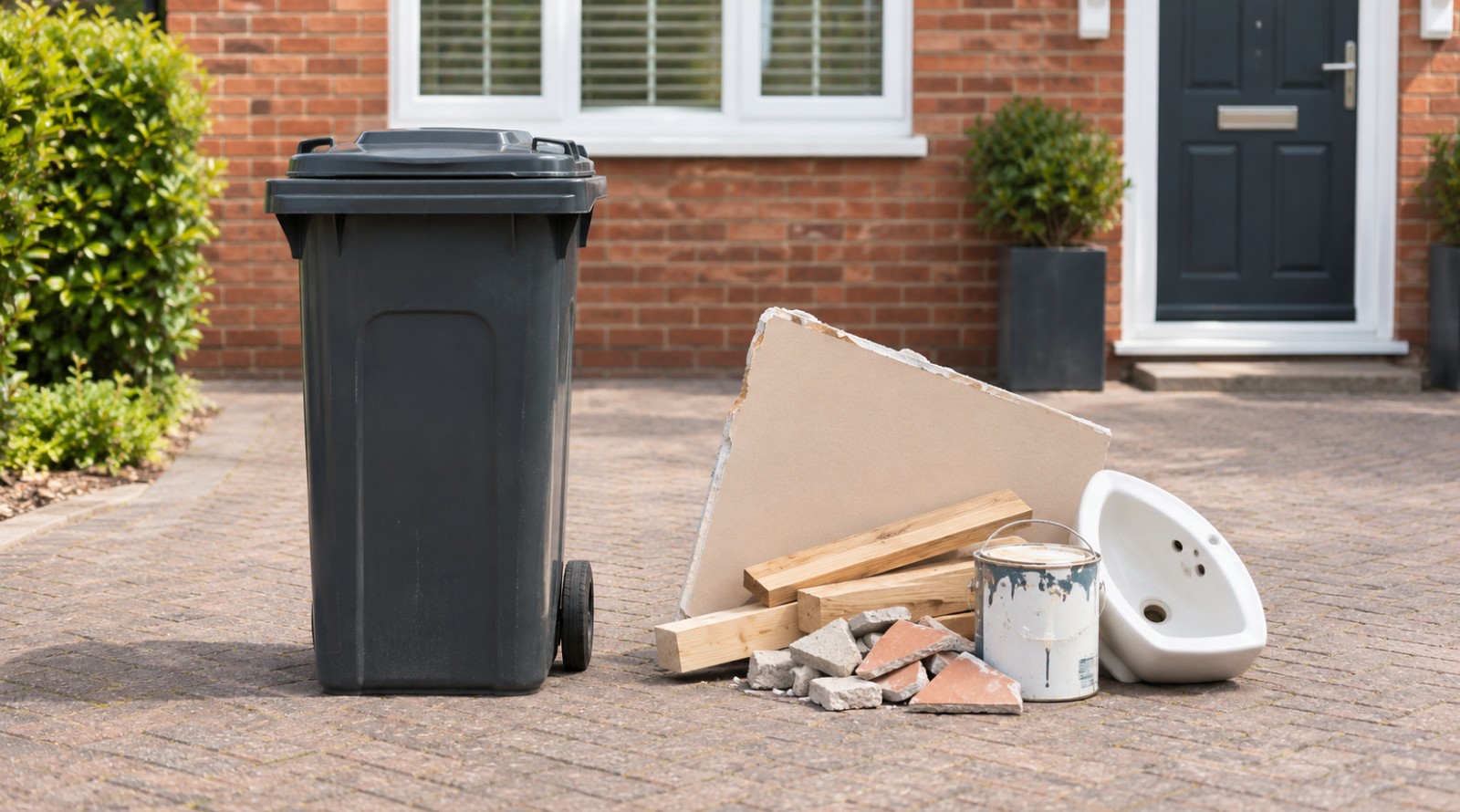
If you are stripping out a bathroom or redoing the kitchen, the wheelie bin looks like the easiest answer. In most cases, it is not. Your household bin is meant for everyday domestic waste, and councils across the UK treat renovation waste as a different category altogether. Put the wrong material in, and your bin may simply be left uncollected.
The short answer: small offcuts from a minor job may be fine, but anything produced by a real renovation belongs at a household waste recycling centre (HWRC), with a licensed carrier, or in a skip. Here is how to tell the difference.
What Counts as Renovation Waste?
Renovation waste is anything generated by building, repairing or stripping out part of a home: plasterboard offcuts, bricks, rubble, tiles, timber, doors, old bathroom suites, paint tins, solvents and wiring.
A single shelf bracket is everyday waste. A room strip-out is not.
What UK Councils Usually Allow in the Household Bin?
Your general waste bin takes non-recyclable household waste, what is left after you have recycled everything you can. Most councils explicitly exclude rubble, soil, plasterboard and large timber from kerbside bins, and many will not collect a bin too heavy to lift safely.
Recycling bins are stricter still: they accept only the materials your council lists, and one wrong item can contaminate the rest.
That contamination is why the rules are enforced. A load of recycling containing plasterboard dust or solvent residue may be rejected at the sorting plant, sending good recycling to waste along with it. Before a big clear-out, check your own council’s A–Z of waste on its website, rules differ between authorities, and the list for your street is the only one that counts.
Paint and Plasterboard
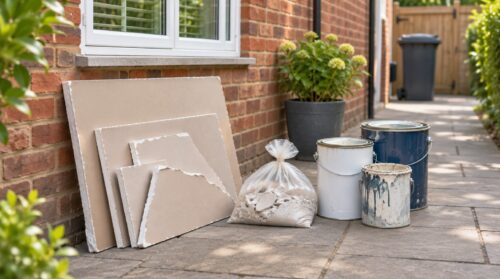
These two cause more confusion than anything else in a renovation, and both have rules of their own.
Paint tins are the easier case. Many recycling centres accept dried-out, water-based paint, and some run reuse schemes that pass usable paint on to community projects.
Liquid paint and solvent-based paint are different: they count as hazardous waste and must go to the hazardous section of a recycling centre, never into the wheelie bin.
Plasterboard must never go in the household bin. Gypsum, its main ingredient, reacts with biodegradable waste in landfill and can release hydrogen sulphide gas, so plasterboard has to be kept separate. Most recycling centres now have a dedicated plasterboard skip, keep offcuts dry, bag the dust, and take them there.
Rubble, Wood and Metals
Rubble, bricks and tiles are accepted at most recycling centres, but often in limited quantities, and trailer loads may need booking in advance.
Since December 2023, councils in England can no longer charge households for disposing of small quantities of DIY waste at recycling centres. Scotland, Wales and Northern Ireland have their own arrangements, so check before you load the car.
Wood is a mixed bag. Clean, untreated timber usually goes in the wood skip and is chipped or reused. Painted or chemically treated wood is often refused from the wood skip and may need the general waste skip instead. Pulling nails out first helps either way.
Metals are the simplest win in a renovation. Copper pipe, brass taps, steel radiators and old wiring are all accepted in the scrap metal skip at a recycling centre, and a scrap dealer may pay for larger quantities of copper or brass.
What Must Go to a Recycling Centre or Licensed Carrier?
Some renovation waste should never go near a wheelie bin at all:
- Asbestos: If you suspect asbestos like old pipe lagging, textured coatings, some garage roof sheets, stop work and get it surveyed. Removal is a licensed job.
- Chemicals and solvents: Paint stripper, white spirit, adhesives and old fuel cans belong in the hazardous section of a recycling centre.
- Gas bottles and fire extinguishers: Pressurised containers are refused from general skips and need a specialist route.
- Electrical items: Old wiring, light fittings and appliances fall under electrical waste rules and go to the WEEE section.
- Large quantities of anything: Once you have more than a car boot full, the practical answer is a skip or a licensed clearance service.
If you hire someone to take waste away, check they are registered: search the Environment Agency’s public register of waste carriers before you book, and ask for a waste transfer note for the load.
Your legal duty of care does not end when the van drives off, if a rogue carrier fly-tips your waste, you can still be fined. Fly-tipping can lead to an unlimited fine and, in serious cases, a prison sentence.
Sorting Waste Before Collection Day
Sorting as you strip out saves a second job later. Keep a separate bag or pile for each material like plasterboard, wood, metal, rubble, general waste and label paint tins so staff can direct you to the right skip. Bag plaster dust rather than sweeping it loose, and keep plasterboard dry.
Sorting also raises the share of your waste that actually gets recycled. WRAP’s household waste research shows that mixed, unsorted loads are far more likely to be rejected or landfilled, while separated materials have a clear route to reuse.
Before a big clear-out, confirm your collection day and any holiday changes, so sorted bags are not sitting on the drive for a fortnight.

For readers who are also managing a property abroad, Trash-Pickup.org publishes local trash pickup, recycling and holiday schedule guides for residents across the US and Canada, a handy reference when a second home’s bin day is not the one you know by heart.
When Booking a Clearance Service Makes Sense?
Sometimes the DIY route stops being sensible. If you have no car or trailer, if the waste is heavy or awkward, or if the job will generate several tonnes of rubble, a licensed clearance service or a skip is usually cheaper than repeated recycling centre trips.
Get two quotes, confirm the carrier’s registration, and ask in advance whether hazardous items such as paint or plasterboard are included in the price, anything a skip company has to remove later usually comes back as an extra charge.
The Quick Checklist
- Wheelie bin: everyday household waste only, and only what your council lists.
- Recycling centre: rubble, wood, metals, plasterboard (separate skip), dried paint and small DIY quantities.
- Hazardous section or specialist route: liquid and solvent paint, chemicals, asbestos, gas bottles and electricals.
- Licensed carrier or skip: anything too large, heavy or plentiful for the car.
- Always: check your council’s rules, keep materials separated, and verify your waste carrier.
Renovation waste is not difficult to dispose of properly, it just has its own set of routes, and the household bin is rarely one of them.